
Fields Inside Tate County Property Tax Records
Taxes in Tate County follow two separate trails. Assessment work sits with the Tate County Assessor/Collector, which keeps the parcel roll and collects the current bill. Delinquent land moves to the Chancery Clerk for redemption. Read any result with that split in mind. The roll names the parcel and year, the assessment builds the taxable base, and the collection entry tells you whether the charge was paid or still stands.
| Record field | Meaning for the parcel | Official source |
|---|---|---|
| Property Owner and parcel | Taxpayer name tied to the parcel as of the annual roll | Assessor/Collector DSM search |
| Tax year and AR Tax Status | The year returned and its accounts-receivable status | DSM result list |
| True and assessed value | Full-value estimate and the ratio-adjusted tax base | Assessor roll |
| Homestead status | Whether a qualifying owner-occupied benefit affects the account | Assessor/Collector |
| Bill and delinquency | Current payment position or redemption history | Collector or Chancery Clerk |
Never read a tax figure as a sale price. Mississippi starts with true value. The constitutional class ratio comes next, then millage. Class I owner-occupied residential property is assessed at 10 percent; other real property in Class II carries 15 percent, and exemptions and local levies can shift the final bill.
Look Up a Tate County Property Tax Bill
Begin online with the official Tate Current Property Tax search. Owner name, parcel number, and address modes all work. Address mode breaks the entry into street number, street name, and city, which helps when one road name crosses a municipal line.
- Choose physical address when the parcel key is unknown; keep the city blank for a rural route if a narrow search fails.
- Open the matching row and record its parcel number, tax year, owner, situs address, and AR Tax Status.
- Compare the account with the assessor's homestead and value information for that same year.
- If the account is delinquent, move to the land-redemption inquiry or call the Chancery Clerk before paying.
- Assessed value
- The ratio-adjusted amount to which tax levies apply, not a sale estimate.
- Millage or levy
- A rate expressed in mills and applied to assessed value by the relevant taxing bodies.
- Homestead exemption
- Mississippi relief for a qualifying owner who occupies the home and meets filing rules.
- Tax lien
- The public claim attached to land when property tax remains unpaid.
The screenshot comes from the official tax search page. It shows why picking the right search mode matters.
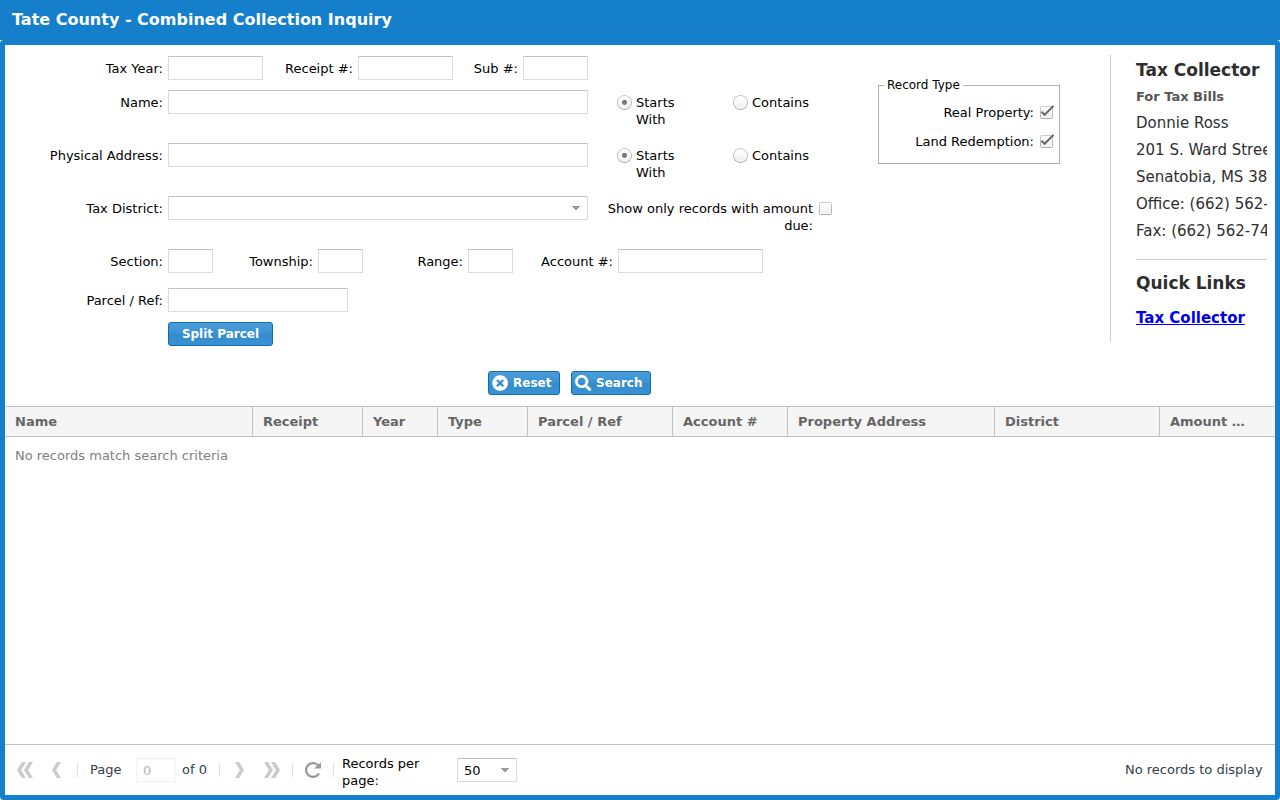
The image is only a doorway. Open the live account and confirm the tax year and current status before treating any amount as due.
Tate County Property Tax Search Fields
Each search mode answers a different records question. An owner-name query can turn up several parcels at once, while the parcel key pins down one exact account. Rural land often lacks a dependable street address. Section, township, and range give those tracts a second route in.
| Mode | Fields available | Best use |
|---|---|---|
| Owner | Last name or company; first name | Find all visible accounts under a taxpayer name |
| Parcel | Parcel number | Reopen an exact account from a bill or map |
| Land description | Section, township, range | Reach rural tracts without a clean situs address |
| Physical address | Street number, street name, city | Start from a known property location |
A result list can display Property Owner, parcel number, tax year, address, city, county, state, ZIP, section, township, range, and AR Tax Status. Note the parcel and year. Those two keys keep every later check aligned.
Tate County's January 1 Roll Can Lag a Deed
Ownership on the assessor side is stated as of January 1 because that is the tax-lien date. The county FAQ adds a practical cutoff: a deed must be filed with the Chancery Clerk by December 31 of the prior year for taxes to appear in the buyer's name. Taxes are paid one year in arrears.
This timing can leave a prior taxpayer on a Tate County property tax record even after a closing. Do not try to fix that mismatch by treating the roll as title evidence. Compare the deed date with the roll year, then use the Chancery Clerk's latest recorded instrument when present ownership matters.
Note: The county does not publish an average number of days for an owner-name update after the annual cutoff.
Mississippi Ratios Shape Tate County Property Tax
Mississippi multiplies true value by the constitutional assessment ratio, then applies millage. Class I owner-occupied residential property uses 10 percent. Class II, other real property, uses 15 percent. The class applies before any homestead benefit shows up.
There is also no single Tate County millage rate. The published table splits county, school, and municipal pieces, including Coldwater City and Senatobia City where they apply. A postal city proves little. A parcel can carry that mailing address yet sit outside the city's taxing boundary, so rely on the parcel location and taxing district rather than the ZIP line.
Homestead Dates in Tate County Tax Records
The Mississippi Department of Revenue sets the homestead filing window from January 1 through April 1. The Tate County Assessor/Collector runs the local application. Regular homestead, age or disability relief, and the disabled-veteran tier each carry different qualifications. Use current state guidance and county instructions.
Some changes force a new filing. State guidance flags shifts in ownership, marital status, occupancy, or property description. Gather what the county asks for. Last year's entry will not carry over automatically after a deed or life change.
Note: Confirm current homestead documents with the Assessor/Collector before the April 1 close of the filing period.
Delinquent Tate County Property Tax and Redemption
Current bills and delinquent land run through different offices. The Assessor/Collector answers questions about the current bill. The Chancery Clerk handles redemption of delinquent land. The DSM redemption inquiry accepts owner, parcel, section-township-range, physical address, tax year, exception code, and an option to include history.
Real-property taxes fall due February 1 under the county FAQ. A one percent penalty is added each month after that date, and delinquent land sells on the last Monday in August. Current pages direct tax-sale users to GoV Ease registration and training. Sale dates and lists shift, so confirm the year's notice with the county rather than an old result.
For a possible redemption, call the Chancery Clerk at 662-562-5661 for a current figure. A portal row can point to the right account. It cannot replace the office's payoff and redemption instructions.
Contest a Tate County Property Tax Assessment
Start with the Assessor/Collector. Ask how the value, the classification, and the exemption were each entered. Bring the parcel number. Bring the disputed year. Bring the notice, and any papers that speak directly to the parcel's condition or classification. Evidence aimed at one point beats a folder of everything. The land roll stays open for public inspection before the Board of Supervisors hears objections in August. If the dispute survives the county level, Mississippi Department of Revenue guidance opens an ad valorem appeal route to the Board of Tax Appeals. The state petition identifies the taxpayer, county, property, tax type, period, issue, requested relief, and grounds. Supporting documents should target the exact point being challenged.
Protect the deadline. File the local objection during the August review cycle, then observe the state's 20-day deadline for an ad valorem valuation appeal from the county decision.
Office and Public-Records Fallbacks in Tate County
A dead tax site is not a dead end. Call or visit the Tate County Assessor/Collector at 201 S. Ward Street in Senatobia, 662-562-6011. Weekday hours run 8 a.m. to 5 p.m. For delinquent-tax and redemption records, the Chancery Clerk at the courthouse is the fallback.
Keep any request to one parcel and one year. No parcel number? Bring a tax bill, a deed reference, or the full physical address. Ask what the answer reflects. The current collection account, the annual land roll, and redemption history answer different questions. Exemption disputes need the benefit and filing year. Payment disputes need the payment date and receipt details. And sensitive account data should never travel through an open email.
Broader requests still need shape, so narrow them by date, field, and format. One parcel's assessment notice and value history is easier to process. It beats demanding everything tied to an address. If material is withheld, the Public Records Act calls for a written denial. That denial must identify the exemption. Much of the land roll is public. Appraisal material and individual tax information can still fall under specific Mississippi exemptions.
A focused written request also works under the Mississippi Public Records Act of 1983. Tate County's form lets a requester inspect, copy, or reproduce records. The requester can also choose a delivery method. Advance payment of actual compliance cost applies when required. State law caps fees at actual search, review, duplication, and mailing costs. Name the parcel, the year, and the exact tax record sought.
For the amount and meaning of an assessed figure, the Tate County property value guide separates assessment from market indicators. It also separates sale consideration. Those figures are not a tax-bill calculation.