
Route from a Tate Address to Its Property Owner
Each record does one job well. The tax roll turns a Tate address into a parcel number and a taxpayer name. The GIS map verifies the parcel. The Chancery Clerk's deed index then tests whether a newer grantee has taken title since the annual roll was published.
- Enter the physical address in the Tate Current Property Tax search and choose the matching parcel.
- Read the exact Property Owner field and copy the parcel number, year, and situs address.
- Compare the tract in CMPDD GIS, using PPIN and legal-description fields to avoid a same-road mismatch.
- Search the latest deed in RecordsUS by the owner name and inspect the newest transfer involving that tract.
- If the grantee is a business, use Mississippi SOS Business Search to resolve the exact legal entity name.
This sequence beats a name-only web search. It stays reliable. It also keeps a clear note of which Tate County source supplied each fact and the date attached to it.
Three Tate County Records That Identify a Property Owner
Each source plays a different role. Update rhythms differ too. Use the comparison to decide whether a displayed property owner is a search lead, a spatial cross-check, or evidence of a recorded transfer.
| Where ownership appears | What it contributes | Currency limit |
|---|---|---|
| DSM assessor/collector roll | Property Owner, parcel, tax year, situs and tax status | Annual January 1 ownership snapshot |
| RecordsUS land index | Recorded grantor, grantee, date, instrument and images when available | Newest filed deed can postdate the roll; online coverage is 1990-present |
| CMPDD parcel GIS | Ownername beside PPIN, situs, acreage, legal and deed references | Parcel source name carries a March 8, 2022 date |
Owner of record does not mean occupant. A trust, estate, corporation, or absentee owner can hold title while someone else uses the site. Property records answer a title and tax question, not who is physically present there.
Read Tate's Exact Property Owner Field
The Tate Current Property Tax portal labels its result column `Property Owner`. Search modes include owner name, parcel number, section-township-range, and physical address. Address mode accepts street number, street name, and city.
Copy the Property Owner spelling exactly once a row appears. Keep initials and entity suffixes. Retain the parcel number, tax year, address, city, ZIP, and any section-township-range values. Those keys matter. They tie the deed and GIS checks to the same Tate County tract.
The official tax portal page displays the entry routes available before a result opens.
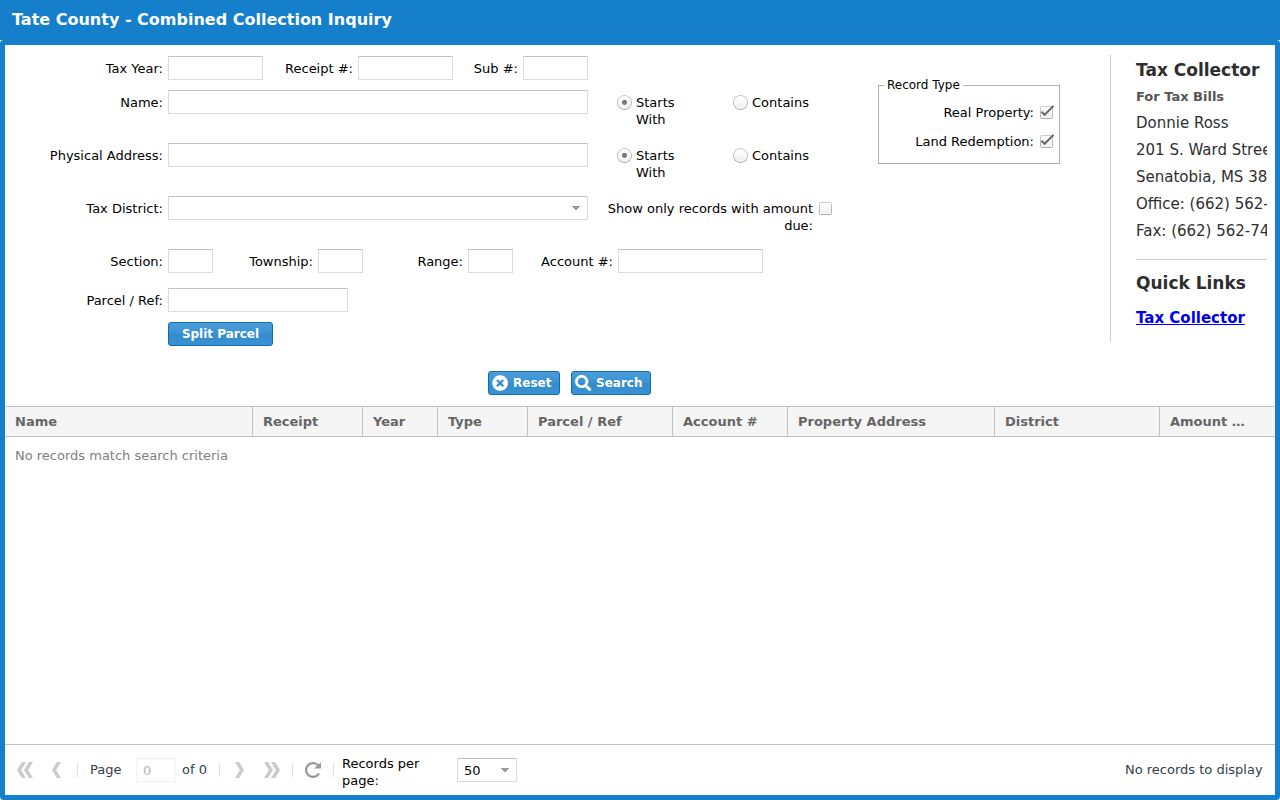
Use the live Tate row, since annual tax records can change.
Why January 1 May Not Answer Who Owns It Now
Tate County's assessor warns that ownership reflects January 1, the tax-lien date. The county FAQ adds a cutoff rule. A deed filed by December 31 of the prior year puts the buyer on the next tax roll. Property taxes are also paid one year in arrears. A purchase recorded after the cutoff can leave the seller's name on a page that looks current.
The county publishes no average refresh interval. So compare dates. When a deed date is newer than the roll's ownership date, the deed is the stronger current-transfer clue. That deed check settles the gap.
Note: Always record the roll year and deed filing date when two Tate County owner names conflict.
Confirm a Tate Property Owner in RecordsUS
The Tate County Chancery Clerk is the land-record custodian. Its county page links to RecordsUS. A free user account can be used, and free public terminals are available in the office. Online Tate land-index coverage runs from 1990 to the present.
Search the owner as grantor and grantee. Then match the instrument to the legal description, subdivision, lot, acreage, or deed book and page. A common name alone proves nothing. If an image is watermarked or requires a fee, use the clerk's counter or request a certified copy when the purpose demands one.
RecordsUS is not the only channel. The Chancery Clerk offers free public terminals at 201 S. Ward Street in Senatobia and answers focused calls at 662-562-5661. A mailed or Public Records Act request should name the parties, the approximate recording date, the instrument type, and a parcel or legal-description clue. Ask for inspection first when unsure.
Older instruments need different tools. Ask the clerk for deed books and indexes. MDAH microfilm is another route. The Tate County Genealogical and Historical Society works too, listing deed books A-C for 1873-1879, D/E/G indexes, and an 1894-1935 index.
GIS Legal Fields Keep the Tate Tract Straight
CMPDD GIS exposes `legal1`, `legal2`, and `legal3` fields. PPIN, parcel ID, subdivision name, deed book/page/date, and situs address come along too. These fields shine when an owner holds several tracts or the postal address is incomplete.
Search or zoom to the location, then click the parcel polygon. Compare the legal fragments with the deed result. A GIS ownername can be stale. The parcel source carries a 2022 date. Use it to identify the tract, not to overrule a later deed.
Tate County Property Owners Named as Estates, Trusts, and LLCs
Tax rolls often abbreviate. EST, ET AL, or a suffix like LLC are common. Keep the spelling exact and try variants. An estate name hints at probate. Chancery records may hold a will, administration file, or court order that explains the transfer. A trust is different; only the deed itself names the trustee and the vesting language.
Court files can close the gap when land skips an ordinary deed. Tate County sits in the Third Chancery Court District. Public case information runs through Mississippi Electronic Courts or courthouse terminals. A sealed case is the exception. Search by the decedent or estate name. Then match any court order to the land description before drawing a conclusion.
For an LLC, the Mississippi SOS Business Search accepts a business name, business ID, officer name, or registered-agent name. It also offers several criteria modes and a date range. It helps separate similarly named entities. Still, it never replaces the recorded deed as proof of ownership.
- Owner of record
- The person or entity named by the relevant roll or recorded instrument.
- Grantee
- The party receiving the interest in a recorded deed.
- Title versus ownership
- Title is the legally supported bundle of rights; one database label is only evidence to assess.
- Situs versus mailing address
- Situs locates the land; mailing address is where notices go and may be elsewhere.
City-Edge Addresses Need a Tate County Check
A Senatobia 38668 or Coldwater 38618 mailing line does not prove city limits. Rural routes carry those place names too. Other Tate localities and ZIP areas also overlap neighboring geography. An address search may return several candidates. Compare the Tate_Municipalities and Zip_Codes layers to sort them out.
Old Coldwater has a twist. The town moved about 1.5 miles south in 1942 for the Arkabutla Lake and dam project. So a historic deed or map may reference the original setting. That old geography can explain a mismatch. Current ownership still turns on the present parcel and the latest deed.
Limits on a Tate County Property Owner Lookup
A roll name, GIS label, or index hit is not a title opinion. It cannot show every unrecorded claim. It will not resolve conflicting legal descriptions or prove who occupies the land. A transaction or a disputed title belongs with a title company or attorney. A boundary question belongs with a licensed surveyor.
Know when to stop. A do-it-yourself check ends once instruments conflict. The grantee name cannot be matched to the tract. Probate stays unresolved. A legal description changed after a split. Bring the parcel keys, deed references, and dates to the professional. That search record beats a bare owner name, because it shows where the uncertainty began.
Lawful use only. Use Tate County owner records for property diligence, title research, estate work, or civic transparency, never to stalk, harass, or defeat a protected address.
Mississippi's Address Confidentiality Program shields the locations of eligible victims. It works through a substitute address and mail forwarding. Public offices must keep those locations confidential. Recorded deeds can also hold identifiers subject to redaction rules. Never republish Social Security or financial-account numbers.
If only the present roll entry matters, the Tate County current owner page zeroes in on the annual owner-of-record snapshot and the deed-date check.